500 Sunsets
Or "Down with Beauty!"

(I feel a bit guilty posting this on the day after the election but I’m going to post it anyway. At least it’s a distraction.)
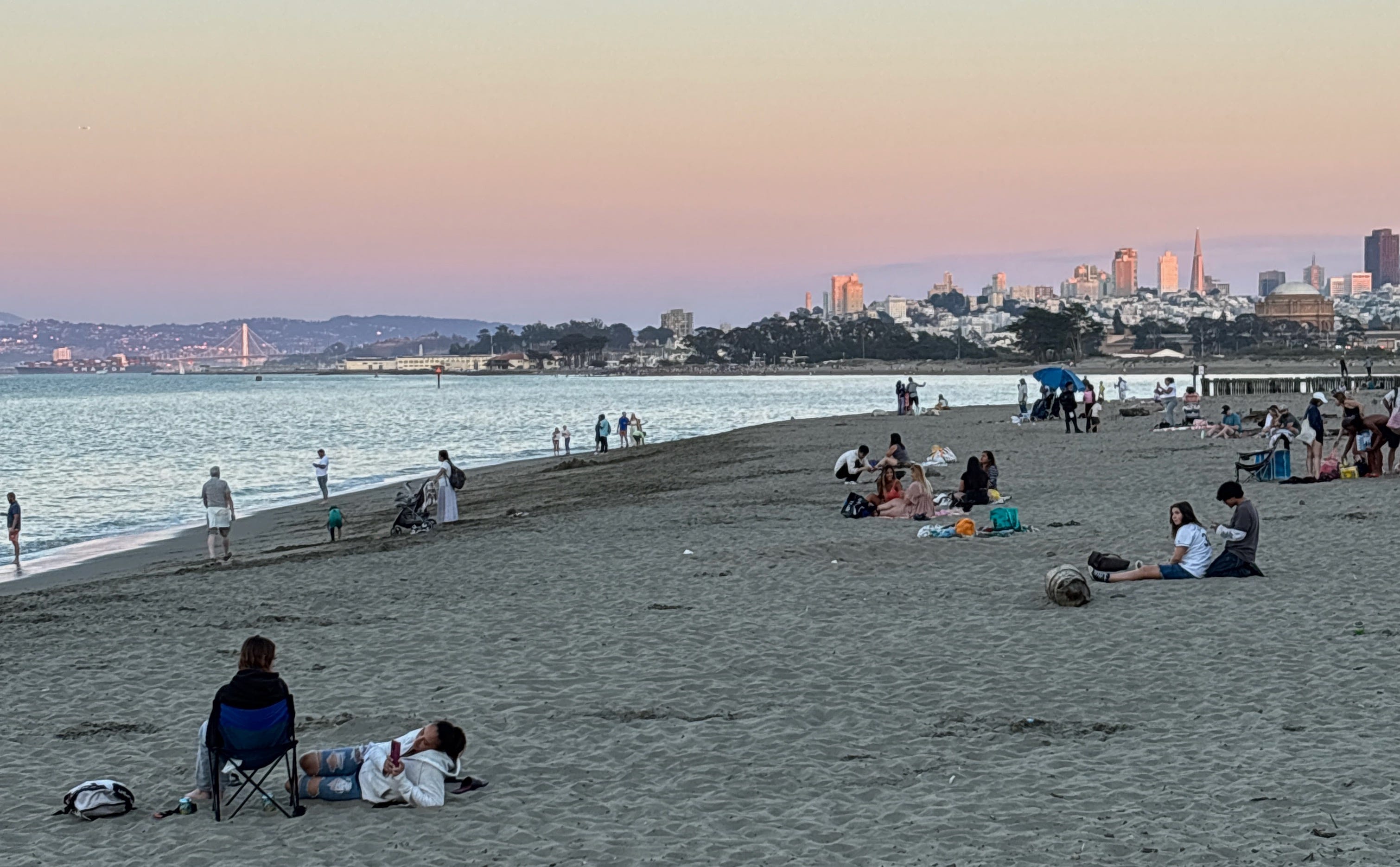
Some friends were rhapsodizing about how beautiful the sunset was one evening recently and I got annoyed by the mindlessness of it and started pushing them on the sunset. What was it they liked about sunsets and why?
“It's beautiful,” they said, having racked their brains for a moment to find out why they liked sunsets .
This irritated me and I began harassing them mercilessly about what that meant. I badgered them to define beauty. Not an easy one, this, and generally out of favor since the Romantics in favor of "the sublime," defined (I informed them) as introducing "awe and terror" into beauty.
At this point I realized I was behaving like an asshole and guiltily stopped. However, it left me thinking about sunsets. I always thought the sunset was a Romantic invention, like mountain climbing, forest walking, sea bathing and communing with nature in general --Romantic with a capital R, that is, meaning the movement in philosophy and the arts that replaced Classicism around the turn of the 19th century. The Romantics wanted what you were seeing to have an edge on it. You were supposed to like not the beautiful but the sublime, the beautiful being too close to just pretty, and hence trivial
It's not that I dislike sunsets, I just dislike watching friends go into that automatic state of enthusiasm whenever the sun begins to set, as if it gives them a regular jolt of dopamine. Of course everybody likes sunsets, as everybody likes puppies and kittens, etc. It's a knee-jerk response. But I maintain it's a Romantic invention, Nobody went up a mountain before 1800 unless they had to, nor did they hike in the dark forest and marvel at the sublimity of raging cataracts and looming peaks. All that stuff was invented by the Romantics, German or English, I tell myself., and so was the sunset.
**** .
Most of the English Romantic poets wrote poems about sunsets -- certainly Coleridge, Shelley and, Byron. The best one, actually about a lot more than the sunset, is Wordsworth's famous ode "Lines written a few miles above Tintern Abbey" (1798). We see him getting a hit of the sublime:
...a sense sublime
Of something far more deeply interfused,
Whose dwelling is the light of setting suns,
And the round ocean and the living air,
And the blue sky, and in the mind of man;
A motion and a spirit, that impels
All thinking things, all objects of all thought,
And rolls through all things.
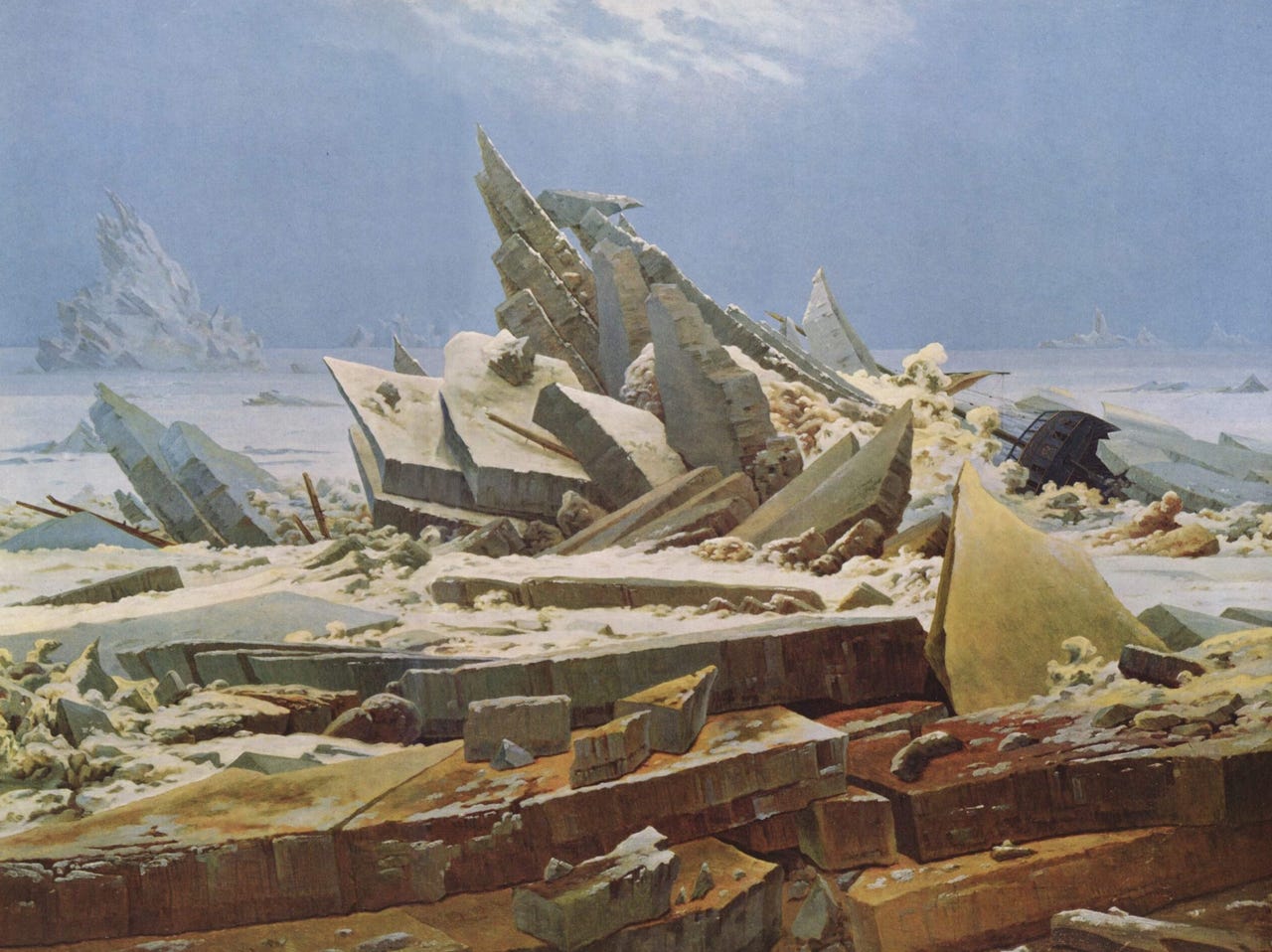
He's getting an oceanic feeling, a kind of low-intensity psychedelic vision. This was new, I guess, in 1797 when he wrote it. In the sunset he sees "the motion and spirit that rolls through all things" -- that is, he sees a version of God, in God's new Romantic incarnation as Nature. He sees the sunset as uniting "all thinking things" (us) with "all objects of all thought" (nature, the world). This is the Romantic Sublime in action as opposed to the plain old beautiful. He gives us a hit of the awe and possibly terror that was supposed to define the sublime. (Actually in the Romantic iconography terror was more associated with jagged peaks, raging torrents, plunging abysses and so forth. Or see Caspar David Friedrich's marvellous "The Sea of Ice," below).
"For I have learned," Wordsworth continues,
To look on nature, not as in the hour
Of thoughtless youth; but hearing oftentimes
The still, sad music of humanity,
Wordsworth is out of fashion these days but you can't beat that
****
****
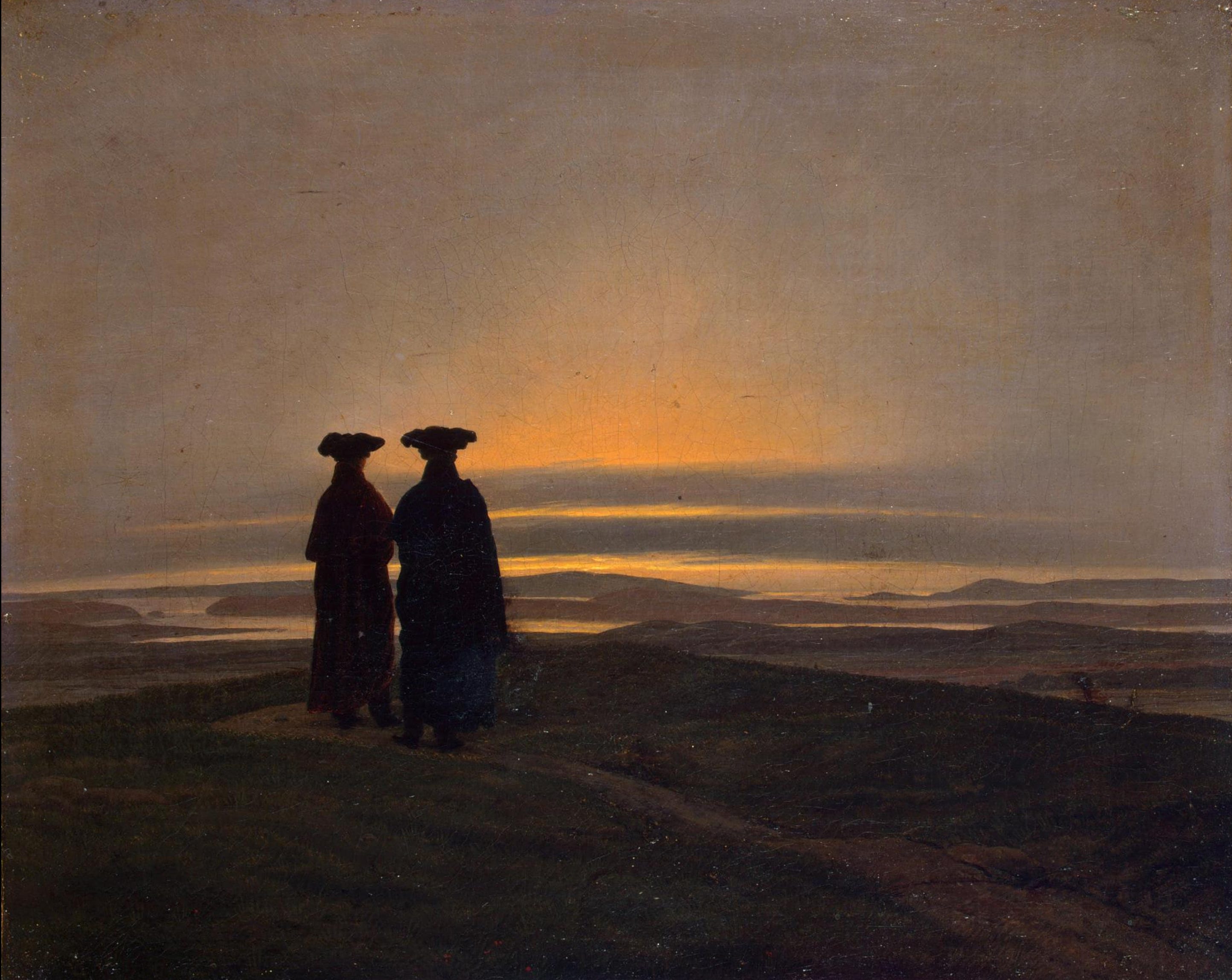
The Romantic painters, German and English, loved sunsets. The same Caspar David Friedrich, my favorite, did a bunch of them. Below is the most famous one, "Evening Landscape with Two men," (1836). Friedrich liked to insert a couple of "rückenfiguren" as they are called, figures seen from the back, into his mysterious landscapes (or seascapes) to carry you into the event.
Turner, the great English Romantic painter, did a whole bunch of sunsets too. This is "The Lake, Petworth: Sunset, Fighting Bucks"(1829) and below it "The Scarlet Sunset " (1830).
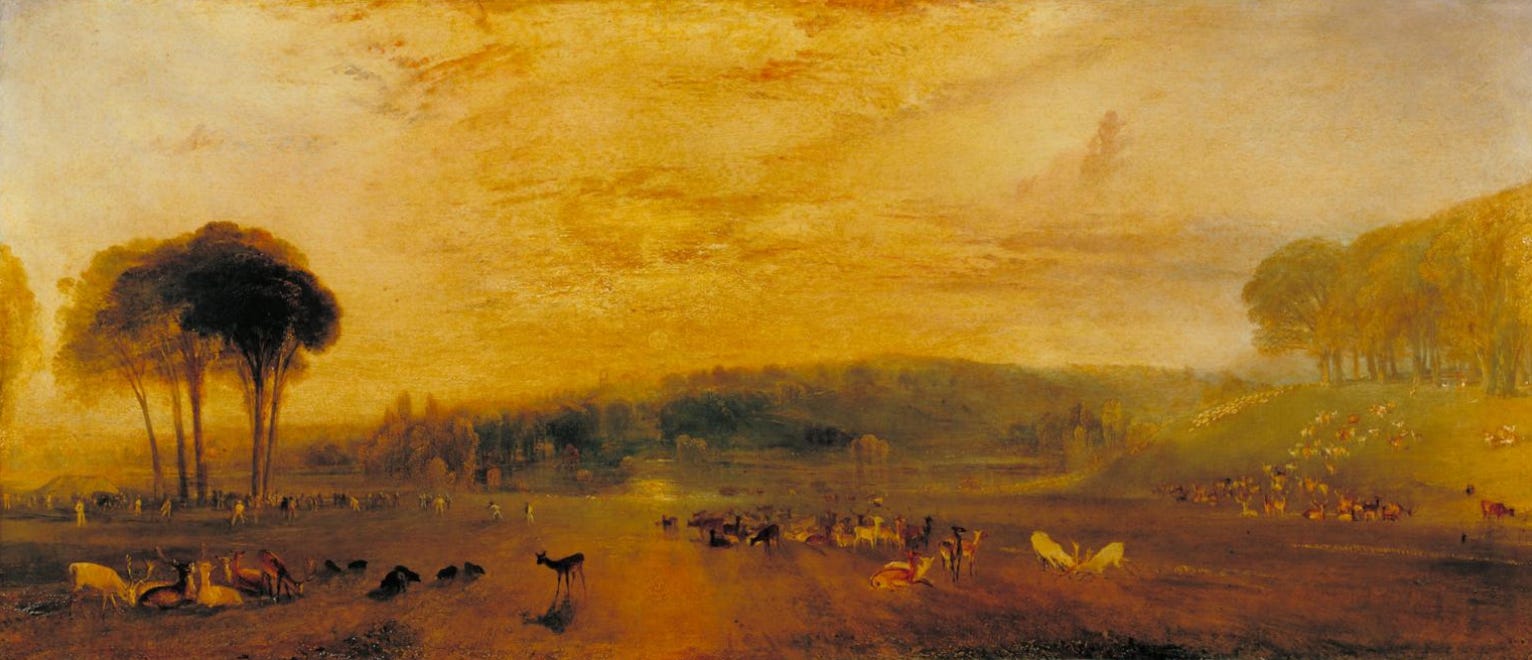
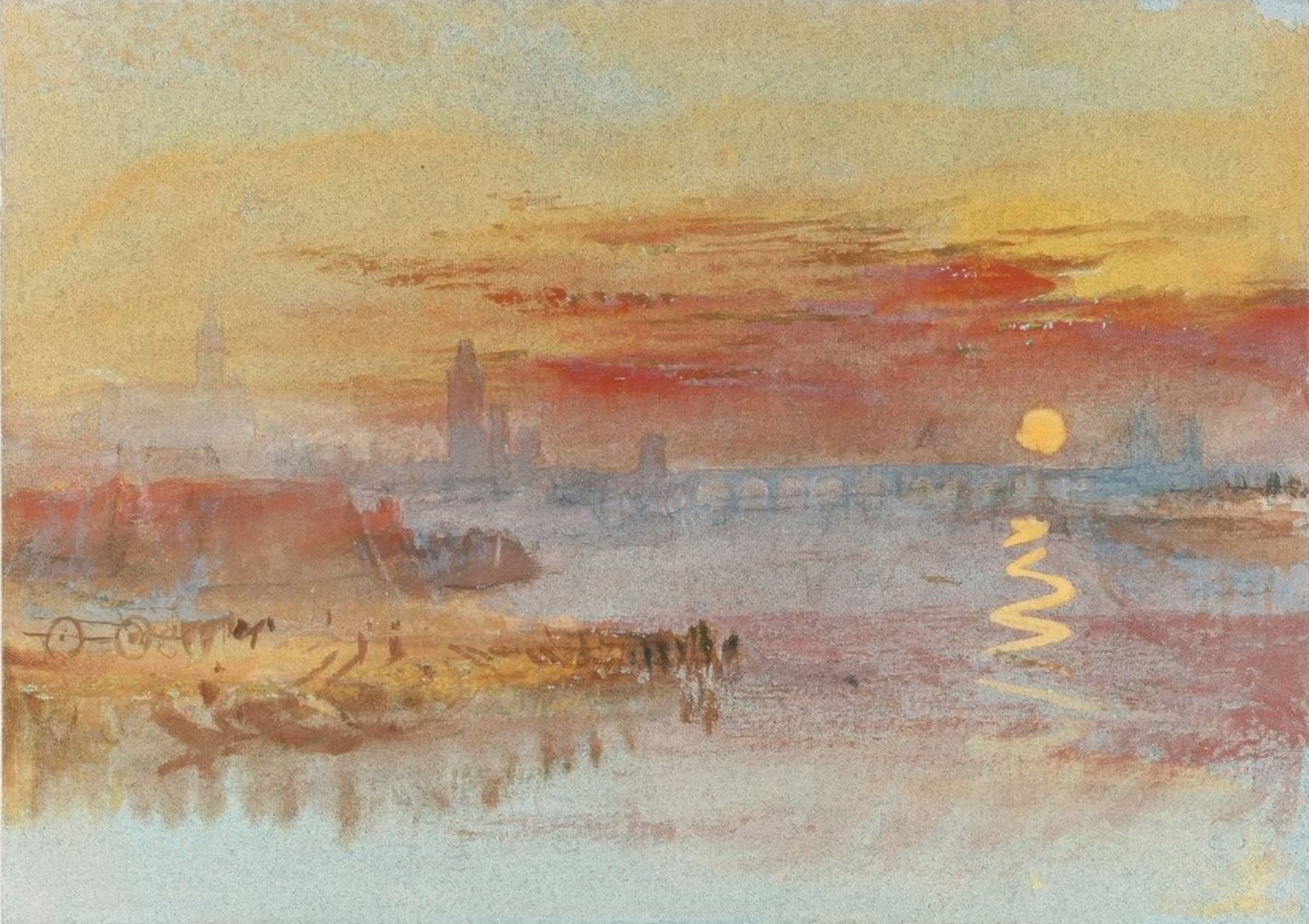
There is a very unromantic story about the sunset colors in these paintings that I'll get to in a moment.
****
Since I don't actually know anything about all this I began wondering if it really was the Romantics, German or English, who invented the sunset, along with all that other stuff they invented around 1800. I put out a call on Facebook for earlier examples of sunsets and Rebecca Solnit came up with this:
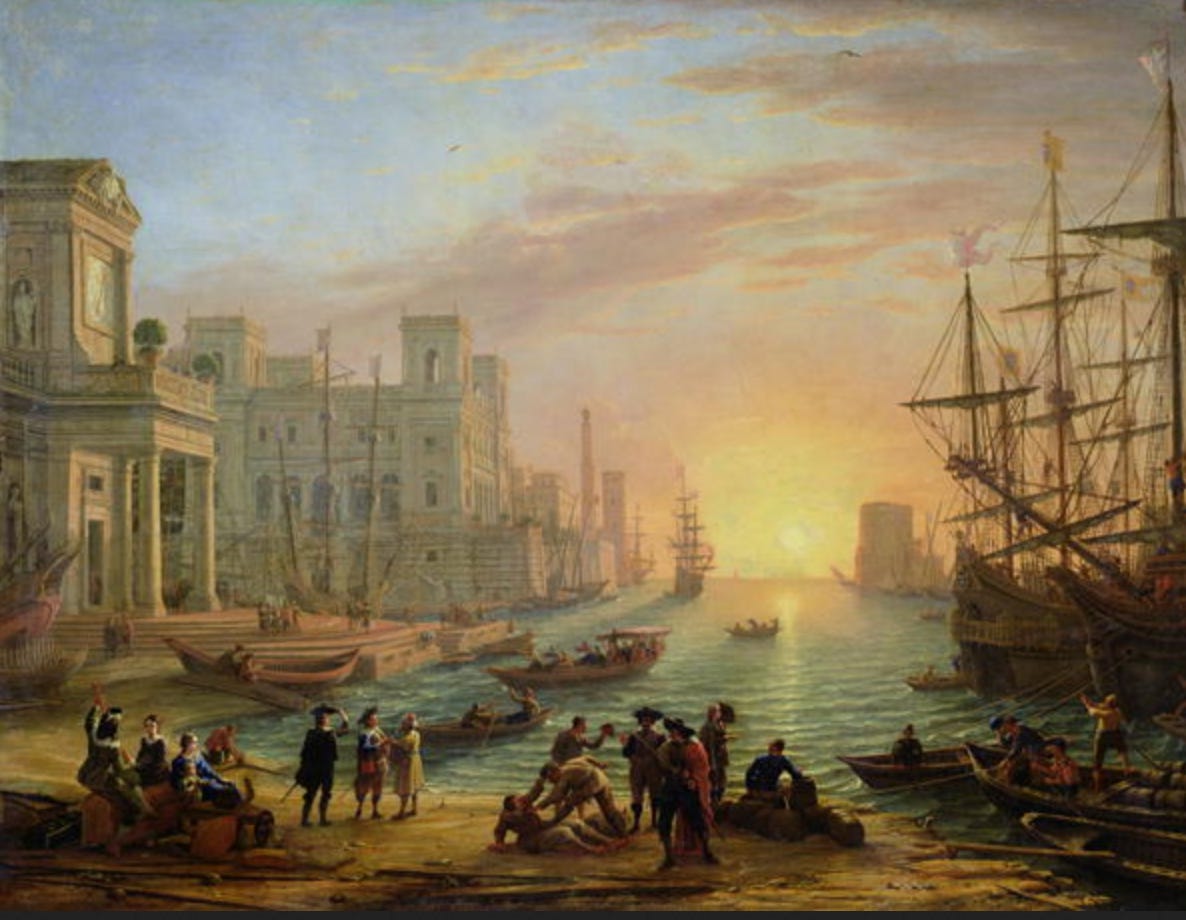
It's Claude Lorraine's "Seaport at Sunset" (1639). Claude did quite a few of these; he seems to have fallen in love with ports at sunset.
I pushed further, looking for a Renaissance sunset and Ms Solnit came up with Bellini's "Agony in the Garden” (1465), with Jesus in the center asking if God could let him off the hook
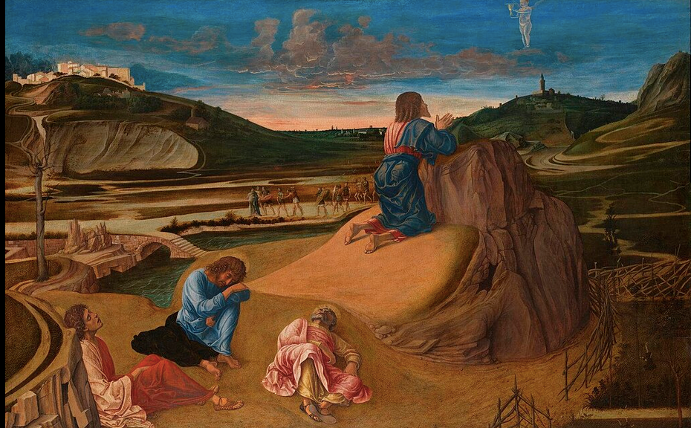
Research reveals, however, that this is actually not a sunset but a sunrise, which you can tell because the disciples, lower left, are still asleep.
For an actual renaissance sunset. Here's "Il Tramonto," ( 1506 ) by Giorgione. "Tramonto" apparently meaning sunset, but literally "behind the mountain," because, I suppose, the sun was always setting behind some mountain in Renaissance Italy.
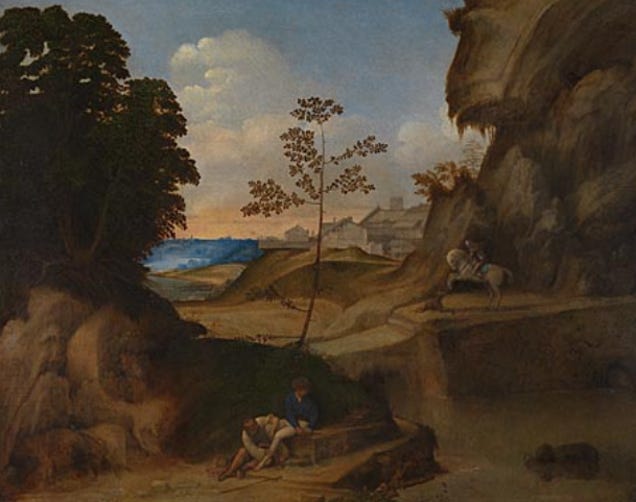
The little St George on a prancing horse in the middle is apparently a restorer's invention of 1934. This is a very appropriate painting for an epidemiologist such as myself because in the foreground is Saint Roch protector against plagues, having his bandages attended to by his companion Gothardus. And in the cave in the right background is the barely visible Anthony Abbot, protector against epidemics. However, the plague got Giorgione in 1510.
The sunset is apparently original but it's kind of wimpy.
****
From the other team, as it were, there's this, from Dr Christian Zerefos. Dr Zerefos reported in the journal Atmospheric Chemistry and Physics in 2007 that the aerosols created by volcanic eruptions changed the red-green ratios in the sunsets painted over five hundred years of painting. The Daily Climate (March 30, 2014) reported:
“Dr Zerefos and his team analysed hundreds of high-quality digital photographs of sunset paintings created between 1500 and 2000, during which time there were 50 large volcanic eruptions around the globe.They were looking to find out whether the relative amounts of red and green along the horizon of each painting could provide information on the amount of aerosols in the atmosphere.
“Dr Zerefos said: ‘We found that red-to-green ratios measured in the sunsets of paintings by great masters correlate well with the amount of volcanic aerosols in the atmosphere, regardless of the painters and of the school of painting.’
“Skies more polluted by volcanic ash scatter sunlight more, so they appear redder and similar effects are seen with mineral or man-made aerosols.Air with a higher amount of aerosols has a higher 'aerosol optical depth' - a parameter the team calculated using the red-to-green ratios in the paintings. They then compared these values with those given by independent proxies such as ice core and ‘volcanic-explosivity’ data to find a good correlation.
“[Turner's] celebrated work "The Lake, Fighting Bucks," painted at Petworth near Chichester in 1829, is a clear demonstration of the effect.
“Lead author Christos Zerefos, a professor of atmospheric physics at the Academy of Athens in Greece, said: "Nature speaks to the hearts and souls of great artists. But we have found that, when colouring sunsets, it is the way their brains perceive greens and reds that contains important environmental information."
****
I give the somewhat depressing Dr Zerefos credit for locating upwards of 500 sunsets to work on, including the Turner above. (The earliest sunset cited is Gerard David's "God the Father Blessing," (1506), which I will resist the temptation to reproduce.) Anyway, sunsets appear to go back as far as you like. So as for the Romantics inventing the sunset, fuggedaboudit. On the other hand they did try to get some of that awe and terror into their sunsets, or at least make them something a little more than pretty.
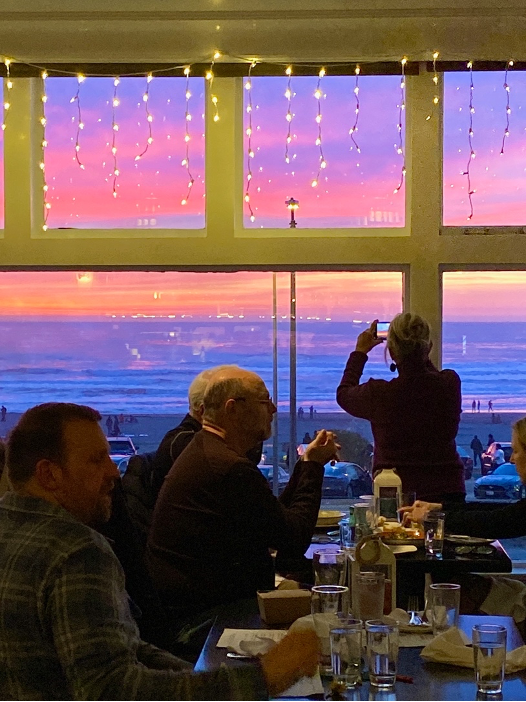
I have to admit that I do take the occasional sunset photograph myself. Here's one, from the Beach Chalet in San Francisco. Lacks awe and terror, I admit. Possibly an example of the Comic Sublime?