
Bring Back Ulysses S Grant!
A statue tour of Golden Gate Park, or where Black Lives Matter went wrong.

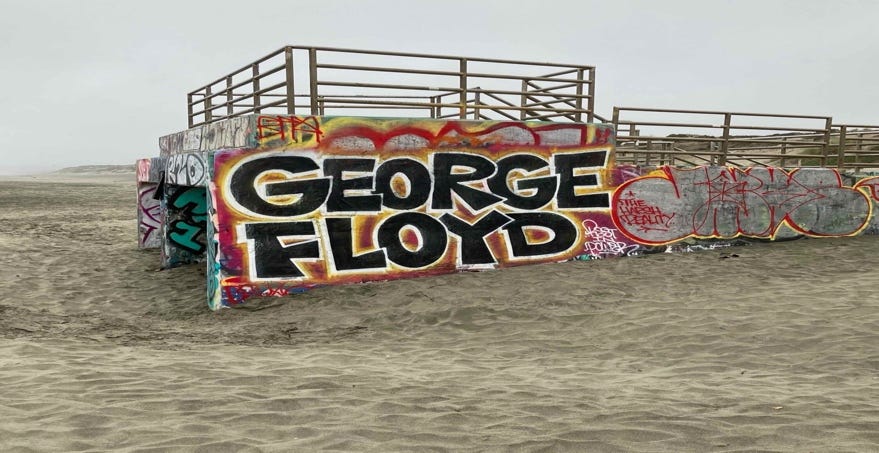
I like statues. I like them enough that I recently offered some friends I walk with a statue tour of Golden Gate Park for our monthly walk date. Most of the park statues are conveniently clustered around the Music Concourse, the great open space full of neatly trimmed plane trees between the DeYoung Museum and the California Academy of Sciences, and I thought this would make it easy to do a statue tour. I knew that some of the statues had been targets of the post-George Floyd rioting, but I didn’t realize how much that was going to piss me off.
The Music Concourse was the site of the California Midwinter Exposition of 1894, a knock-off of the great World’s Columbian Exposition held the year before in Chicago. The Midwinter Exposition left a few statues behind, including the flute-playing boy who can still be seen hypnotizing a panther in the lily pond northeast of the De Young museum, and also the sword-brandishing green Leonidas, Spartan hero of the battle of Thermopylae, near the Western end of the DeYoung.
Most people think the green warrior is a gladiator, but he isn’t, he’s the leader of the 300 mythical Spartans who told Xerxes the Persian king, when he offered to let them live if they would abandon their weapons, “Come and get them!” This remark (molon labe in Greek) is now a bumper sticker in extreme right-wing circles. Leonidas is Belgian, originally cast in Brussels in 1881, making him the oldest sculpture in the park. He was spotted on display at the 1893 Chicago exposition by Michael DeYoung, Director General of the Midwinter Exposition (and founder of the art museum) and imported.

Statues have their history, which is the history of the city they find themselves in, and thus our own local history. Most of the statues in Golden Gate Park were erected between 1880 and the First World War, and they reflect the powerful nationalisms of the era. Verdi at the southwest corner of the Music Concourse was paid for by the Italian community of San Francisco and was dedicated in 1914 in an enormous rally of 20,000 people at which coloratura Luisa Tetrazzini, the city’s pet soprano, sang an aria from Aida. One year later the German community of San Francisco competitively erected the looming bust of Beethoven a short distance east of Verdi, near the Academy of Sciences building and now a favorite skateboarding venue. And in 1919, the Irish (protestant) nationalist and revolutionary Robert Emmet got his sculpture, dead center in front of the Academy building. Around a third of the population of San Francisco was Irish at the time. Emmet was executed by the British in 1803 and gave a famous speech at his trial, quoted on the back of the statue.
Emmet’s statue, donated by former mayor and then Senator James Phelan, was unveiled by Eamon de Valera, future president of the newly declared Irish Republic. De Valera quoted Emmet’s speech to a crowd estimated at 80,000 people, the largest gathering to date in Golden Gate Park. (The Chronicle reported that the crowd crushed the ivy plants because there was nowhere else to stand). Robert Emmet is lucky that he’s still there in front of the Academy of Sciences because James Phelan was a notorious racist, anti-Japanese agitator and proponent of the Chinese Exclusion Act of 1882. Emmet could easily have become a target of the statue-smashers of 2020
But before we get to the iconoclasts (”image breakers” in Greek), here is one more expression of local nationalism. The double sculpture of Goethe handing the laurel wreath of poetry to his anointed successor Frederick Schiller stands just to the northwest of the Academy of Sciences building (though it’s currently obscured by unpruned trees). Impressed by the success of German Day at the Midwinter Exposition, a vintner named Charles Bundschu, half of the Gundlach-Bundschu winery, began a fundraising process that included a “Goethe-Schiller Festival” of “German life, literature, manners and customs.” (“Pretty girls will be met wherever the spectator turns,” said the Examiner). They eventually raised enough money to import a bronze replica of a statue of the two poets that had been erected in Weimar in 1857.
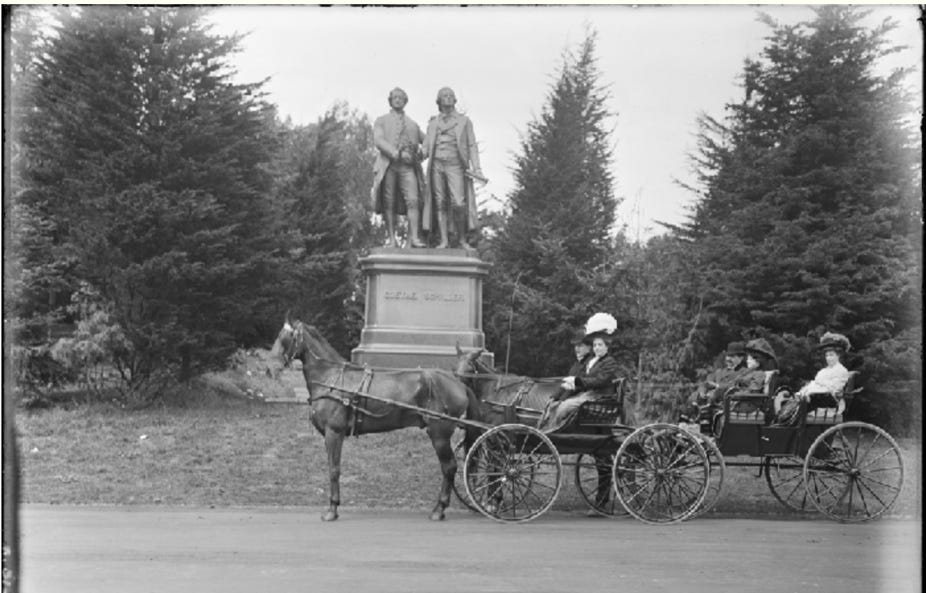
However, this idea did not go over well with local artists and artisans, angered that the monument, though paid for locally, had been imported from Germany. James Phelan, who was then president of the SF Art Association, represented the local artists and the debate between Phelan and Bundschu played out at length in the press. (Phelan actually wanted to hire James Tilden, who did the famous Junipero Serra statue, toppled in 2020). Eventually Bundschu and Phelan negotiated a compromise: the monument would be imported as planned, but the pedestal would be made of locally quarried and cut marble, worked by local artisans. And so it was. The Goethe-Schiller monument, local pedestal included, was erected near the Japanese Tea Garden and then moved to its current location in 1932.
Statues move around. A speeded-up film of the Music Concourse since the Midwinter Exposition of 1894 would show the statues whizzing around like crazed beetles. Francis Scott Key, who like Junipero Serra is no longer with us, was moved three times before he got to his (now empty) monument in the Concourse.
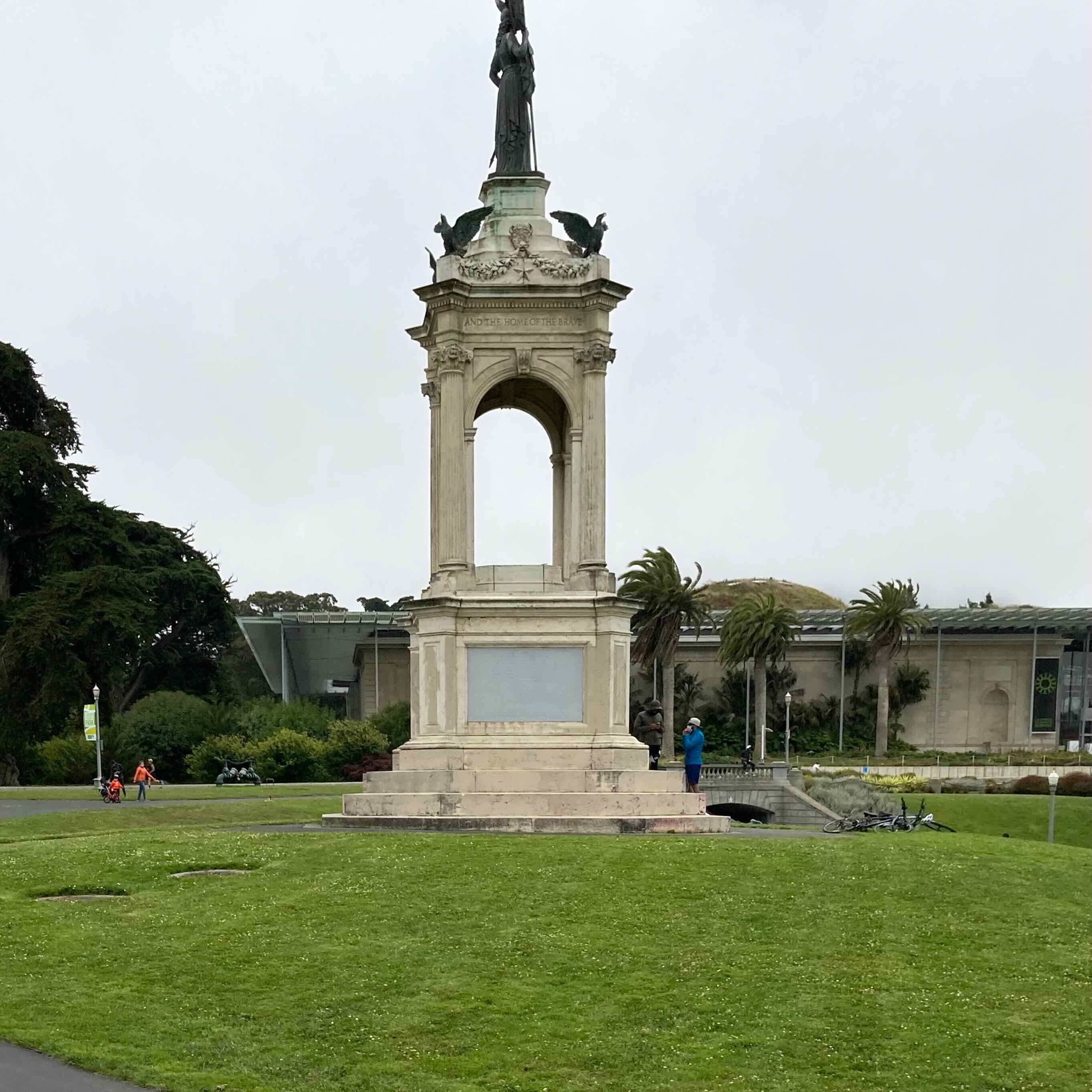
So, on to the iconoclasts of 2020 and the now-missing statues of Francis Scott Key, Junipero Serra and Ulysses S Grant.
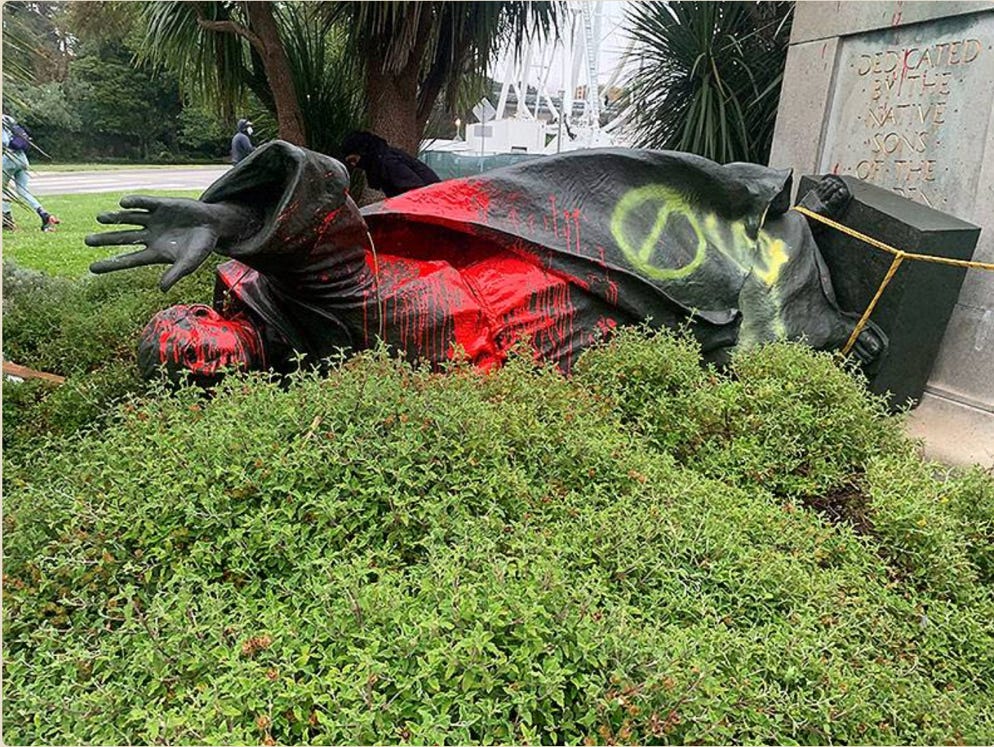
San Francisco’s own Black Lives Matter activists descended on the Music Concourse on June 19th 2020, toppled Francis Scott Key, Junipero Serra and Grant and red-painted a bunch of other statues including the nearby monument to Cervantes. The date, June 19th, is “Juneteenth,” the date in 1863 when the news of Lincoln’s Emancipation Proclamation finally reached the remote garrison of Galveston, making the date a symbolic final point for the ending of slavery.
I have no particular affection for Francis Scott Key, author of the national anthem and apparently a slaveowner and enemy of abolitionists (he owned eight slaves at the time of his death, says Wikipedia). I like the monument, though, a gaudy, almost surrealist temple of nationalist sentiment with Columbia on top and four chicken-like eagles surrounding her. Leaving it up and empty seems to me a teachable idea. And Junipero Serra, a harsh and punitive colonizer in the Mission System that killed so many native Californians, seems eminently dethronable. Serra’s statue was another James Phelan production, commissioned from Douglas Tilden, the famous deaf sculptor who did the
Mechanics Monument on Market Street, and the fantastical Volunteer Monument now at Market and Dolores. Tilden was a baroque sculptor whose monuments are full of energy and aggression, ideal for Phelan’s nativist imperialism. Gray Brechin in his book Imperial San Francisco writes of Phelan that “the Jesuits at St. Ignatius College and [his] grand tour of Europe fired him with the ambition to give his city a mythology appropriate to its place. He accordingly endowed it with statues meant to teach citizens their role in the westward march of the master race….”
But Ulysses S Grant is another story. Grant had one slave, William Jones, given to him by his repulsive and slave-owning father-in-law. Grant was clearly uncomfortable with the gift and got rid of Mr Jones shortly. But he didn’t sell him. Forgoing the several hundred dollars the enslaved Mr Jones was worth, Grant manumitted him — gave him his freedom. This is the sum total of Grant’s wickedness (his wife, admittedly, owned a few more slaves). This would hardly be enough for Grant to be icon-smashed even if it wasn’t for what’s on the other side of the scales. But there’s a huge weight on the other side of the scales. Grant won the civil war! After his victories at Vicksburg and Chattanooga, President Lincoln put Grant in command of all the armies and charged him with defeating Lee, which he grimly did. Grant was the man who won the civil war (“He fights!” Lincoln said admiringly) thus ending slavery. “To Grant, more than any other man, the Negro owes his enfranchisement” said Frederick Douglass.
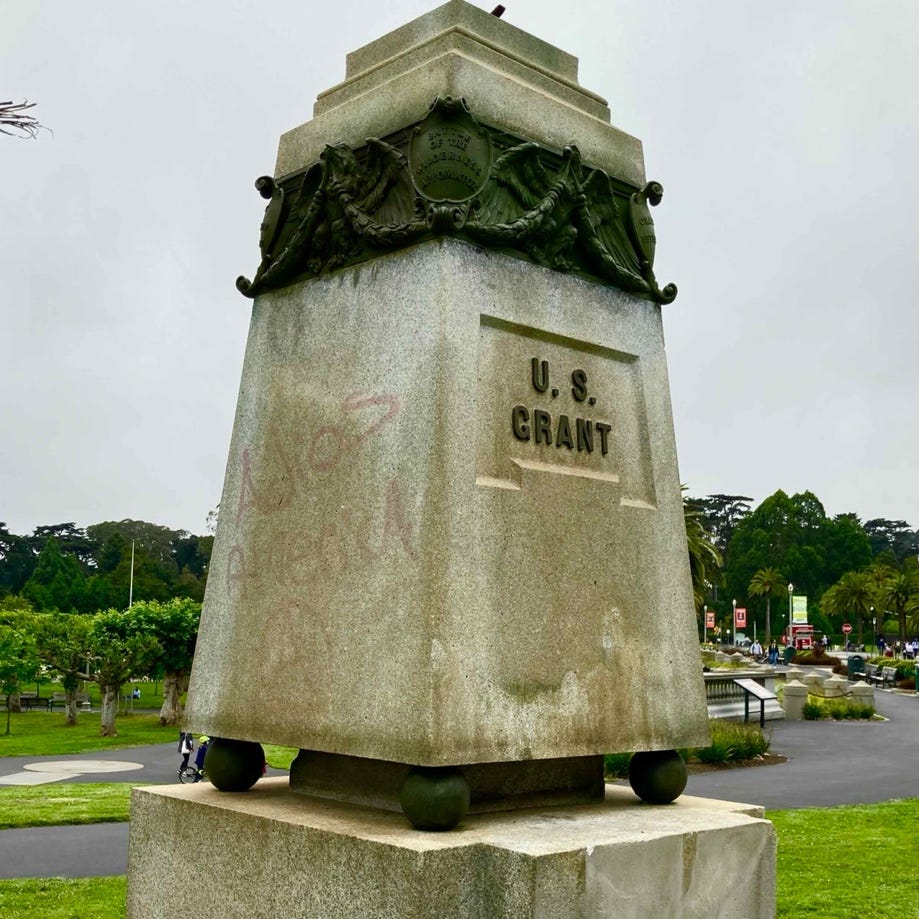
This being the case, how come he got the chop? The Juneteenth activists were either ignorant or self-righteous to the point of insanity, and the city of San Francisco was slavishly compliant with their ignorance/arrogance. Grant is still missing.
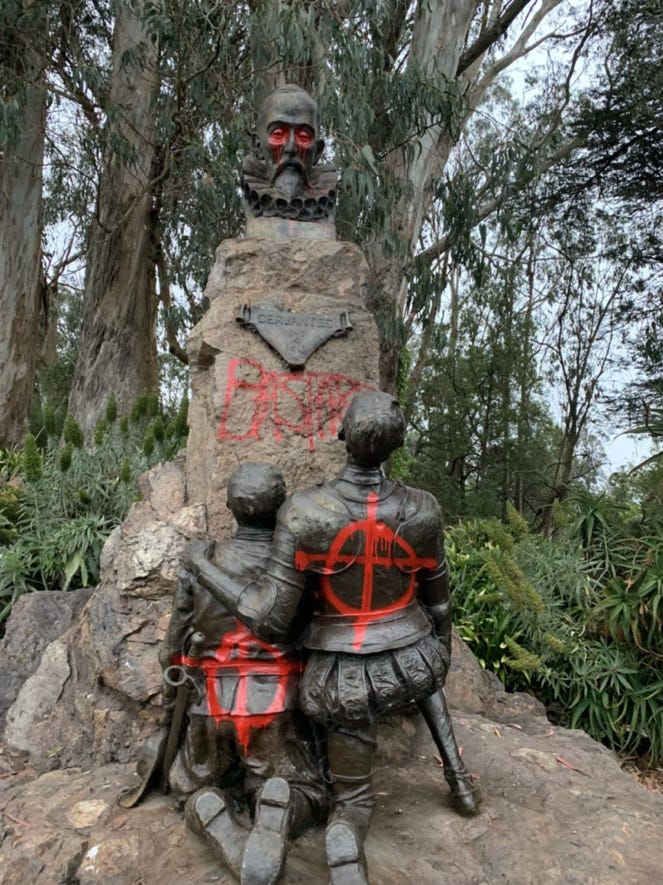
All this was enough to turn me against the iconoclasts of 2020 and then I saw the Cervantes monument. This shows Cervantes’s famous characters Don Quixote and Sancho Panza looking up at a bust of their creator. On June 19th the two characters were rather crudely daubed with red-painted anarchist cross-in-a-circles and the word Bastard in red was painted across Cervantes’s pedestal. In a slightly more artistic touch his eyes were also painted red.
Now Cervantes, in addition to being a world-historical writer, was himself a slave. He was captured by Barbary pirates in 1575 and enslaved for five years until he was redeemed by a religious order, the Trinitarian Friars. To red-daub Cervantes in what promotes itself as an anti-slaveowning protest is plain pathetic. Stupid. “This movement has gone far enough,” I thought.
And so had my tour, which had followed an ellipse around the Music Concourse, beginning with the flute-playing boy and ending up back at the DeYoung with Grant and Cervantes. I was a somewhat crazed student radical myself, back in the white hot days of 1968, and probably almost as arrogant and ignorant as the Juneteenth vandals. But I can’t find it in myself to forgive them. Like the misbegotten attempt to rename the San Francisco public schools and the attempted censoring of the mural at Washington High School, this stuff is way over the edge. Bring back Ulysses S Grant, I say. Dig him out of the warehouse, wherever it is, and put him back on his pedestal. And no more adolescent bullshit masquerading as politics.
Lagniappe: John McLaren, founder of the park, has his statue at the Rhododendron Dell a little east of the De Young Museum on Kennedy Drive. It was commissioned in 1911 by Alma Spreckels, wife of the sugar king. But McLaren hated statues and it was kept hidden in a stable until after his death in 1943, when it was finally put on display. McLaren was right: it’s a very unimpressive statue.
beautifully researched and written, Andrew. After the rains stop, I'd love
go on a tour with you or you and your walking group.
I generally agree. But I think there's a bit more about Grant. He was stationed Humboldt County in the 1850s, and I was fearful that he participated in the notorious massacres of native peoples. In your research, did you come across anything about that?