
Ward 86, Chapter 17: How we Closed the Baths
March 1984. 500 cases

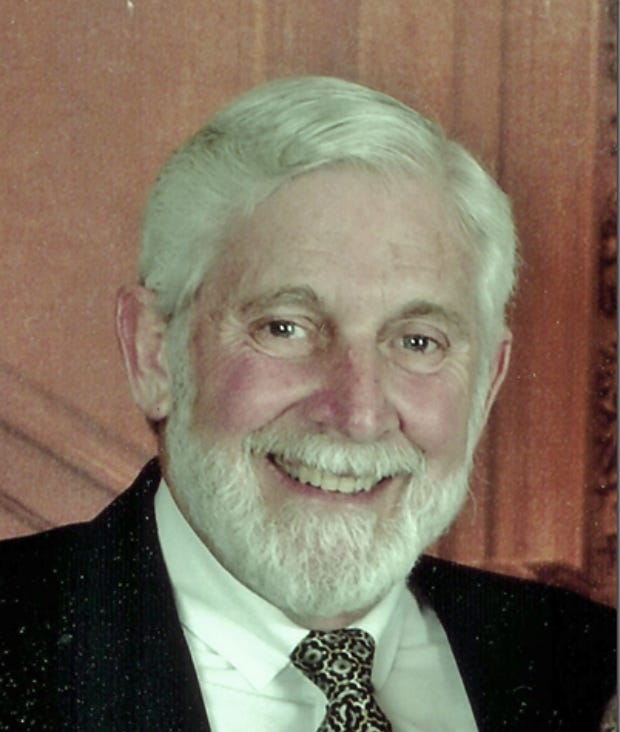
Why is this man smiling?Alone among public health figures across the country, Silverman was to be forced in this period to confront openly the cross-pressures of those who viewed the bathhouses as dangerous to public health and those who saw them as important because of their… symbolic significance in the struggle for the defense of the freedom of the gay community.[1]”
1
In mid 1984 a man named Larry Littlejohn finally forced Mervyn Silverman, the city Health Director, to close the bathhouses. It had taken a year and a half.
Larry Littlejohn was a sheriff’s deputy and a long–time gay activist, one of the founders of the Society for Individual Rights, the first major gay rights organization in San Francisco. His activism went back to the sixties and the foundational era of gay liberation. Those were the days of the famous drag queens’ riot outside Compton’s Cafeteria in the Tenderloin, which actually preceded Stonewall, and of the Council on Religion and the Homosexual, the organization uniting gay activists and allied religious ministers. The police harassed the Council’s New Year’s Eve dance in 1964, spying on and photographing gay members and the Protestant ministers who were their allies. Herb Donaldson, Louise’s friend and now a Municipal Court judge, refused to allow the police to enter the dance and was arrested. Herb thought it was the end of his legal career[2].
Larry Littlejohn began bombarding Merv with letters saying the bathhouses should be closed in the spring of 1983, the moment when everything AIDS related heated up in San Francisco. Merv didn’t take it seriously. “I feel it would be inappropriate, and in fact illegal, to close down the bathhouses and other such places that are used for anonymous and multiple sex contacts,” he wrote to Littlejohn in May 1983. “It is my belief that we would insult the intelligence of many of our citizens and it would be an invasion of their privacy to take such an action.[3]” This was the beginning of a stalling campaign which lasted about a year, until Littlejohn finally stampeded Merv into action by threatening to put the bathhouses on the ballot.
I couldn’t understand Merv’s inaction until I came across an interview with Selma Dritz in the Randy Shilts archives. It was about my own study, my incidence study which Shilts had written about and which had come out as a letter in the Lancet in April 1983. Whatever you can say about that study, about my own ham-handedness with releasing it, it did stir things up in San Francisco. But Silverman, apparently, ignored it. He said as much in his interview with Sally Hughes in the Bancroft oral history of AIDS in San Francisco:
Silverman Let me see how to put this. The results of that study were no surprise. If you go into the Castro, which has the highest concentration of gay men in San Francisco, and you find a higher incidence of AIDS in the Castro, what does that tell you?….I remember people responding, and my scratching my head and saying--
Hughes What’s new?
Silverman Yes. It’s almost like saying, when you go to Miami Beach, there’s a lot of problems with people who have chronic ailments. Yes! Miami Beach is full of old people! [laughter] I guess the lack of any major response from the health department had a lot to do with the fact that there wasn’t a lot of news there
“Or the fact that you’re an idiot,” I wrote in my diary. Merv just didn’t get it. Worse than that, he didn’t read the Lancet letter. And in her interview for the Bancroft oral history Selma said something similar: “he didn’t know he had a problem “.
He didn’t know he had a problem. I think Silverman just didn’t take it seriously. In March 1984 when Larry Littlejohn raised the ante on him, he didn’t take the bathhouse issue seriously either.
2
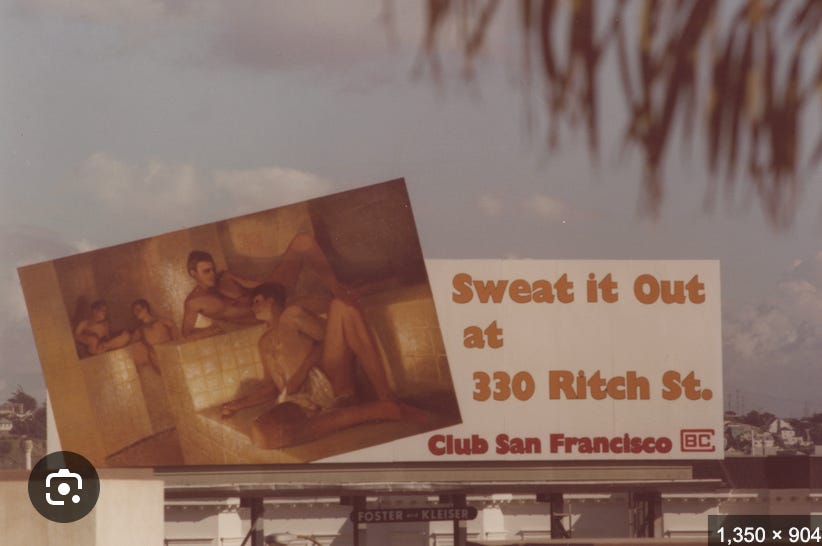
I was never in a gay bathhouse till they were closed. I was in the Ritch Street baths with an English documentary film crew in 1987, a couple of years after the big bathhouses were (mostly) closed down in San Francisco. Ritch Street, actually called the Club San Francisco, was an exotic bathhouse with fluted pillars, marble lounging platforms and a white colonnade around a pool. It was patterned after “the temple of Minos in ancient Greece,” according to David Clayton, an owner. Clayton was at a meeting we held with bathhouse owners on Ward 86 in April 1984, when the bathhouse wars heated up—he seemed to be an owner with a conscience. Ritch Street when I saw it looked like a fake-elegant setting for a Hollywood-style orgy, and it undoubtedly had been. The place was empty when we filmed and the pool was dry. But Ritch Street had been big business in its time. The whole bathhouse industry was big business. In spring 1984 one bathhouse owner estimated his establishment was serving 12,000 customers a week. Arthur Lazere, past president of the Golden Gate Business Association, a gay chamber of commerce, said “Anybody who’s owned a bathhouse for a number of years has made a great deal of money from it…The big ones are big-money business.” [4] It was big-money business and, in the middle of a sexually transmitted epidemic, we in Ward 86 thought it was a murderous business too. But closing the bathhouses split the gay community and on Ward 86 it split Donald and Philippe.
Donald and Philippe were the high-visibility gay staff members on a ward where almost all the patients were still gay men. There were two experienced gay nurse practitioners on the ward, Gary Carr and J.B. Molaghan, but neither had the kind of charisma Donald and Philippe had.
Philippe, whose T cells are point four, is –- what? What is Philippe? Philippe is the center of Ward 86, the physical center of the ward, presiding at his desk opposite the peony-pattern bronze doors of the elevator, facing the incoming patients, dealing with the accelerating flow of suffering gay men pouring in. But also, somehow, he’s the spiritual center of the ward, in a particular gay sense. Philippe is a totally committed, extremist theatrical queen. Philippe is chronically faggy. He is in some way the meaning of the thing, the gay thing that is going on here. A volunteer like everybody else on Ward 86, Philippe with his T-cell ratio of point four has chosen to be at the reception desk at the center of this nightmare, soothing the anxious, putting up with the crazies, managing the inward flow of terrified gay men that gets bigger and bigger every week.
“Why do gay men go to the bathhouses, Andrew?” he says, theatrically.
“Why, Philippe?”
“B-because their needs are more c-complicated!”
Donald, just out of his fellowship, is the young prince of Ward 86, high strung, highly tuned, hard to work with. Here he is, Donald, striding past us down the ward, going a little too fast as always, screaming as he passes -- Bobeech! Flipper! Drew! Pablo! Everybody has a nickname: Bobeech is Bobbie, Flipper is Philippe, Pablo of course is Paul. Everybody is held at arm’s length. No engagement! I got pissed off at Donald at first as everybody did (Jay Levy called him a punk), but when I realized what he was doing, when I heard the story of the dying man in his house, I forgave him. “I can do this,” he had told me, meaning he could distance the patients’ pain and fear and so do his awful job. Donald said this when he was telling me about the dying man in the basement of his house, about how he was picking shreds of KS out of the dying man’s rectum.
Philippe, when the bathhouse crisis blew up, was rehearsing two plays by Copi, the Argentine uber-drag queen playwright who was most famous for playing Eva Peron in his own play of the same name. (“The dialogue may shock,” says the jacket copy). The Copi plays in rehearsal at Theater Rhinoceros were “The Homosexual, or the Difficulty of Sexpressing Oneself,” and “Four Twins.” We went to see them en masse at the Theater Rhino as a Ward 86 staff morale builder, and nobody understood them. Copi himself died of AIDS in 1987.
Well… “Queens are the real heroes,” somebody told me.
“I’ve never done it myself,” says Wally, meaning drag. “It takes balls to do that....”
Bobbie, Paul’s administrator and the unsung heroine of Ward 86, was always coming up with morale builders, some more effective than others (e.g. “Best baby photograph” competition, won by Paul). That month the morale builder that Bobbie had cooked up for us was the Moritz Awards, named for Moritz Kaposi. Everybody had to vote for their favorite in each of the following categories:
Best Leading Doc in an AIDS role: Paul Volberding/Harold Jaffe
Best Supporting Doc in an AIDS role: Donald Abrams/Willy Rozenbaum
Best Vehicle Driven in an AIDS role: Dr Volberding’s BMW/ Dr Rozenbaum’s scooter
Best Professional Looking at an X-ray in an AIDS role: Dr Kaplan/Dr Abrams.
Best Professional Walking Down the Hall in a Non-speaking AIDS role: Philippe Roy/ Andrew Moss
Willy Rozenbaum was a visiting clinician from Paris, an associate of Montagnier’s group at the Pasteur Institute. (Actually the LAV virus that would get the French their Nobel prize came from one of Rozenbaum’s patients). Dr Kaplan was Laurie Kaplan, an oncologist working for Paul. Connie, as usual, didn’t figure in the Ward 86 circus. And I, I note, was assigned a non-speaking role in the Moritz Awards. In retrospect I feel rather honored to have been running against Philippe.
I look up Philippe: he has not made it onto the internet, except for a review of Oscar Wilde’s Salome which Philippe directed at Theater Rhinoceros in 1986. And in March 1983, Philippe was in C.D. Arnold’s play King of the Crystal Palace, also at the Theater Rhinoceros. Besides the Salome review the only Philippe-related item I found on the internet was this photograph:

Philippe, with his long face and shadowed eyes, is front left, C.D.Arnold front right. Most of the people in this photograph died of AIDS..
So, Philippe is a cultural figure in gayworld and he is also one of us, here on Ward 86. He is a peer of Donald, our gay doctor, and currently he can be seen sitting on Donald’s lap in that photograph that’s still on display near the reception desk. The photograph is a little disturbing. Public homoerotic (homoaffectionate?) activity is not exactly encouraged on the ward and Donald is one of the ward leaders. On the other hand, it is after all a ward full of gay men. And the photograph is kind of cute. It makes people uncomfortable but nobody wants to take it down.
Philippe and Donald will be on opposite sides of the bathhouse wars.
3
This was in the editorial column of The San Francisco Chronicle on March 16 1984:
… acquired immune deficiency syndrome has become the deadliest known infectious disease to hit America since polio. In San Francisco, the numbers of AIDS victims have surpassed 500; nationally, more than 3600 people now suffer from this syndrome, which has no known cause or cure.
Even more startling are the projected increases in the disease, particularly in San Francisco, the city with the highest concentration of AIDS victims. Dr Andrew Moss of the University of California San Francisco – who for two years has predicted the AIDS caseloads with uncanny accuracy –says that by the end of this year, 1000 gay men in the Bay Area may contract AIDS.
I still had a hard time thinking of myself as the expert. “A person with zero training is doing this,” I wrote in my diary. “It’s amazing I got as far as I got. Reward for (1) being quick, and (2) not chickening out. One of three groups in a crazy patchwork of collaborations…”
The other two groups in the crazy patchwork still being of course the CDC, at the City STD clinic on 4th St, and Warren Winkelstein’s group in Berkeley, now gearing up for their big NIAID-funded collaborative study. Not surprisingly, my colleagues at UCSF were peeling off to work with these high-powered competitors. Donald was working with the CDC and Jay Levy, up on the hill, was looking hungrily towards Berkeley. I felt wounded but that’s the way the business works.
And in fact I had become an official expert. I had been awarded expert status by the National Institutes of Health, the very institution that had rejected me in spring 1983. In the fall, as I was spiraling off into my fit of airborne infection paranoia in Ward 86, I had been invited to Washington to chair a session on gay men at an NIH research workshop on the epidemiology of AIDS. This invitation is what made me an expert. The other chairs were more-or-less heavy hitters. Arnold S. Monto, our site visitor, was a chair and the rapporteur for my own session was James Chin, a cautious bureaucrat who was the head of infectious diseases for the state of California.
The meeting was haunted by a group of actual people with AIDS who had been invited by the organizers. Their presence, a few months after the candlelight marches in San Francisco and New York, was maybe the first official acknowledgement of the new patient activism – of the way “AIDS patients” had defiantly relabeled themselves “People With AIDS.” A man with extensive facial lesions stood at the back of my session, prominently visible in the center aisle between the two halves of the audience, displaying himself out where everyone could see him. He was listing slightly to one side and his face was dark. “Dusky,” I thought, “that’s what they call that.” Small waves of shock ran through the audience as people discovered him.
The CDC had published its case-control study in the fall of 1983. Harold Jaffe was the lead author. As everybody expected, men with AIDS reported a higher number of sexual partners than controls (a median of 60 partners per year in cases versus 27 in STD clinic controls). This suggested a sexually-transmitted agent and, amazingly enough, was the first citable evidence that the thing actually was sexually transmitted (nobody seemed to regard Michael Marmor’s small, early study of 20 cases as citable). It wasn’t a great study and it didn’t seem to get much media coverage. The media silence was surprising to me because in the spring of 1984, as the bathhouse crisis erupted, plenty of gay men in San Francisco still thought that there was “no proof” of sexual transmission - - or at least not enough proof to close the bathhouses.
But worse, the CDC study was the source of serious confusion. The study reported an “important” association between AIDS risk and going to bathhouses. When you looked at the paper, the way they made this association was totally incomprehensible. [5] But they ranked going to bathhouses the second most important risk factor for AIDS after number of partners.
Meanwhile, the university had finally released the Willie Brown money and now in early 1984 we were actually cranking up our cohort study. I was calling it the “San Francisco General Hospital Cohort Study” to take advantage of the hospital’s increasing fame as an AIDS center. Warren Winkelstein over at Berkeley and the CDC were both beginning their cohort studies too and, as all three of us recruited in the Greater Castro, quite a few people were in two of the three cohorts and a handful, who were addicted to volunteering, were in all three. In the usual villagey way of the Castro this led to a new kind of gossip about which famous person was in which cohort. Harvey Milk’s old lover Scott Smith was in ours and so was Cleve Jones, the well-known activist who was Art Agnos’s legislative assistant and a member of the AIDS Foundation board (This does not mean they were infected. Eventually Warren and I both maintained groups of virus-negative followees in our cohorts as a kind of fig leaf, so that being in a cohort didn’t automatically out a person as being infected. I avoided knowing anybody’s test results myself so I could honestly say “No, I don’t know if so and so is infected.”) Cleve Jones was also the founder of the AIDS Quilt, an amazing construct made of individual fabric memorial pieces sewn together that eventually became so huge that it covered arena floors. It still brings tears to my eyes every time I see it, or see a piece of it.
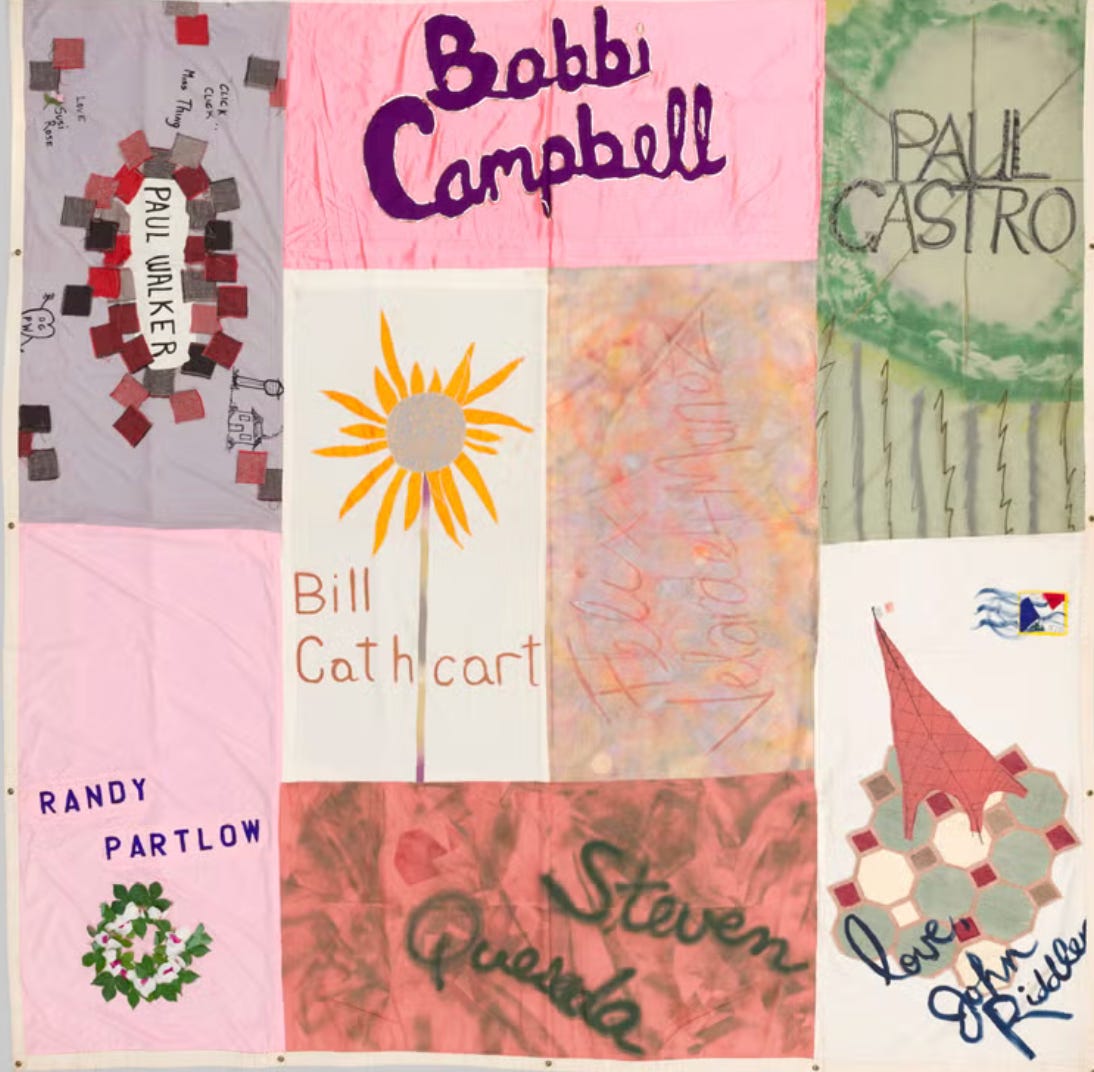
In March 1984 the bathhouse crisis finally blew up. For a year Larry Littlejohn had been harassing Silverman to shut down the bathhouses and sex clubs, totalling somewhere between sixteen and twenty institutions in the city depending on exactly what you counted (Bookstores? Porn theaters?). This had produced a powerful counter-movement which included Pat Norman[6] and my old supporters in the Alice B Toklas club and practically every other gay organization except the Milk Club. This counter-movement saw any attempt to regulate the bathhouses and sex clubs as an attack on gay people’s hard-won civil liberties. The ACLU was gearing up to go into battle. “If San Francisco – the Mecca of gay culture—chooses to close down or regulate public bathhouses,” wrote Thomas Stoddard, director of the New York Civil Liberties Union to his San Francisco counterpart, “it will give incentive to other cities…and in those places, I can virtually assure you, the actions taken will be far harder to keep within reasonable limits.”[7] This was the polite way of saying what many people in San Francisco thought: First they’ll regulate the bathhouses, then they’ll regulate the bars, and then they’ll regulate your bed!
Silverman was stubbornly dragging his feet, making it clear that he thought the civil rights issues were primary, and resisting continuous browbeating from the Mayor, who probably wanted to get the bathhouses closed before the Democratic Convention came to San Francisco in July. Larry Littlejohn kept firing off letters. Pressure was also coming from Randy Shilts, who had pretty much abandoned journalistic objectivity in the cause of shutting down the bathhouses. Silverman’s line was that educating gay men about the risks of sexually transmitted diseases would deal with the problem, and that the bathhouses were the places to do it. Critics, including Littlejohn, said the city’s anemic sexual education program was having no effect and the bathhouses were roaring along as usual.
In March 1984, with about 500 reported AIDS cases in San Francisco, Littlejohn got sick of Silverman’s stalling and decided to take the fight to the mattresses (as it were). He registered at City Hall to put a petition on the November ballot to prohibit sexual activity in the bathhouses and sex clubs.
It only takes about seven thousand signatures to get a petition on the ballot in San Francisco and the voters are notoriously unstable (Jesus Christ Satan got 17,000 votes in a supervisorial election in 1977). Littlejohn’s initiative put Silverman in the hot seat because every politician in the city would now be forced to take a position on the bathhouses as an expression of gay sexuality, right about the time of the Democratic Convention. It would be hard for straight politicians to defend the bathhouses in the middle of an AIDS epidemic (“Defending the right of gay men to commit suicide,” as somebody put it), and it would be even harder for gay politicians to attack the bathhouses. Nobody wanted the bathhouses on the ballot.
At this point everybody in the community took sides, with, as usual, the Harvey Milks and the Alices faced off against each other. I wrote a letter to Silverman saying that we were in a crisis and arguing for “scare” tactics like TV spots showing actual people with AIDS. I also suggested that the bathhouse issue “should be publicly discussed.” This wasn’t revolutionary but in February it was way further than Silverman was willing to go. By the end of March he was up to his ears in public discussion. Selma, cleverly, chose this moment to retire. I told her replacement, a tall, ambitious epidemiologist named Dean Echenberg, that he’d be swamped by AIDS in a couple of weeks and he looked at me as if I was crazy. Three days later he came begging for help. Silverman had informed him that he was the person who was going to “prove” that the bathhouses were dangerous.
Well, how do you prove that bathhouses are dangerous? The bathhouse crisis revolved around “evidence,” meaning evidence that sex in bathhouses and sex clubs was dangerous. It was therefore a crisis about bathhouse epidemiology. But there wasn’t any evidence to speak of. The only data on the issue came from the incomprehensible CDC study and, amazingly enough, by the time the issue finally got into court the CDC’s “important” bathhouse association had melted away! [8]. This drove Dean Echenberg crazy. Having learned a lesson from the Randy Shilts imbroglio of 1983, I kept a low profile with my own data.
Randy was maintaining a high profile. Along with Harry Britt (more or less) and Bill Kraus Randy was running a crusade in the Chronicle to close the bathhouses. I say more or less because when Randy finally got the quote he wanted out of Britt about closing the bathhouses Britt turned round and said no, he didn’t mean that. This kind of reversal was endemic to the bathhouse debate. Randy got a quote out of James Curran of the CDC too – the ultimate authority -- but then Curran repudiated it. Nobody ever quite knew where anybody else stood on the bathhouse issue, mainly because nobody, particularly Silverman, wanted to be the person who closed the bathhouse doors and began the (potential) march to the concentration camps. “First the baths, then the bars, then the parks, then the villages, and before we know it we will all be adorned with a large red scarlet letter and NAZI America will have been born,” as a letter in the BAR put it. I understood Curran’s reluctance perfectly, having been the person who imagined the walls round the ghetto and wavered with my own data in 1983. The first time it’s you on the spot, you start to back away.
I did produce some data for my boss Merle Sande as the first fruits of my case-control study. It got a good shock reaction from Merle, who seemed to have missed the CDC study.
Number of sexual partners Odds ratio for AIDS in year before onset versus neighborhood controls:0-30 1.0
31-250. 2.0
250+ 13.3
The data is not that brilliant, mainly because, as with the CDC study, a lot of our controls were actually infected already, though we didn’t know it yet. But the 13.3 odds ratio for men with the highest number of sexual partners was dramatic. It was enough for Merle to jump up, grab the piece of paper it was written on, hold it up to me and say “Should I tear this up?” I should have said yes (the Ingelfinger rule again) but I didn’t want to overplay it.
This was another of the times I wanted to believe my data was important. I’d like to believe it impelled Merle to crank up his “solution” to the bathhouse crisis, which got Silverman off the hook a couple of days later. But at least it got Merle moving.
March 17 1984
Tiny Dana with his blue eyes and pink cheeks has a round red scab on his right cheek where someone has done a biopsy punch. He was caucusing with Paul about the budget
Paul says there were 24 AIDS cases in the hospital today. There were horrors: the man with the blotched face who I once saw sitting at the end of a table in the cafeteria so nobody had to sit next to him. It was brave, I thought. He is now more blotched. He was carrying over to the hospital a bunch of slips for tests. “What are they?” Donald said, picking them out of his hand and riffling through them. “Oh, x-rays, gallium, all the stuff.”
And early in the day I saw Marty Cox, finally diagnosed with KS in the lung, striding over to the hospital. He didn’t look happy either.
Well, they won’t quarantine the homosexuals during the Democratic Convention. [Governor]Deukmejian might, he’s a Republican. This because Jim Chin is on TV saying what I remember hearing as “quarantine the homosexuals.” I brought it up to Mervyn Silverman and he, flustered, said Jim Chin was close to the lieutenant governor[9].
If they were going to do a quarantine it would have to be now.
About thirty cases a month now.
April 1 1984
Events of the week: Donald, his landlord and the dying man in the basement. “He’s dragging around a corpse,” Donald screamed to me in my office. “Can I smoke?” he says. I motion to shut the door. The dying man is back, he’s ninety pounds. Everybody knows about the dying man in the basement of [Donald’s] house.
Richard, Donald’s lover, thinks we‘re all crazy up here, can’t stand it.
When I asked Volberding about Bobbi Campbell he said “You know as much about it as I do,” referring to my mortality paper. Yes but that’s just statistics.
Paul Castro: “I’m just a statistic to you, aren’t I?”
I say “I know who you are. Everybody knows who Paul Castro is.”
The bathhouse issue began Tuesday, at the Women’s Building. Carole Migden came up and thanked me for sending her a copy of the Silverman letter[10].
I’m going to argue in public for closing the baths
[1] R. Bayer “Private Acts, Social Consequences,” New York,1989, p 31
[2] “Evander Smith, a lawyer for the groups organizing the ball, and Herb Donaldson tried to stop the police from conducting the fourth “inspection” of the evening; both were arrested, along with two heterosexual lawyers.... On January 2, 1965, ministers associated with the Council on Religion and the Homosexual held a news conference in protest of Smith, Donaldson, and the other two lawyers arrested as well as the police harassment to which the ball attendees had been subjected. Twenty-five of the most prominent lawyers in San Francisco joined the defense team.....” https://en.wikipedia.org/wiki/Herb_Donaldson_(lawyer)
[3] The correspondence is in the Randy Shilts archive in the San Francisco Public Library.
[4] Evelyn Hsu and Larry Liebert: “The Big Money in SF Gay Bathhouses.” San Francisco Chronicle Apr 9 1984.
[5] They did a “factor analysis,” of the data, a technique from psychology rarely used in epidemiology, followed by a logistic analysis of the “grouped” and “ungrouped” factors that had resulted from the factor analysis. Then they decided that going to the bathhouses was the second most important risk factor because it was first in the “grouped” analysis, whatever that was, and third in the “ungrouped” analysis. It didn’t appear at all in the “analysis of individual variables.”
[6] “…has the debate shifted from the containment of a disease to the containment of a people?” Pat Norman, quoted in the Advocate, Oct 27 1983. She was running against Harry Britt for his Supervisor’s seat.
[7]Quoted in Bayer, op cit.
[8] This strange process is described in detail in Bayer op cit. While Harold Jaffe had written the original paper saying there was an “important” bathhouse effect, poor Bill Darrow had to walk it back and say there wasn’t.
[9] Chin, the state epidemiologist, had asked for an opinion from the state attorney about quarantining individuals with AIDS who kept on being sexually active. The attorney said they could be quarantined – i.e. put under house arrest, effectively. There were precedents for this with tuberculosis patients. The correspondence was subpoenaed and hit the headlines in San Francisco just as the bathhouse issue broke.
[10] Migden, later a State Senator, was Chair of the Milk Club. It was the letter saying there should be “public discussion” of the bathhouse issue.
High marks, as usual